

How Proscia’s Concentriq platform transforms fragmented workflows into a scalable, AI-ready engine for precision medicine growth.
Precision medicine is the frontier of modern oncology. Precision medicine companies are processing unprecedented molecular volumes, serving distributed health system networks, and racing to deploy AI-driven diagnostics that can meaningfully improve patient outcomes.
However, the infrastructure many of these organizations rely on was designed for a different era: one where digitization meant scanning slides, not orchestrating end-to-end molecular workflows across hundreds of health system partners.
The result is a paradox: world-class science, constrained by analog-era infrastructure. And as volume grows, that constraint compounds.
The limiting factor in precision medicine is legacy infrastructure.
The organizations that recognize digital pathology as a foundational business asset, rather than a departmental IT upgrade, will be the ones that scale efficiently, deploy AI commercially, and build durable data advantages over the next decade.
At Proscia, we built Concentriq to be that foundation. But more importantly, we built it alongside precision medicine organizations as a partner in their growth, not just a provider of tools.
The Three Pain Points Holding Precision Medicine Back
Most precision medicine organizations are aware they have infrastructure challenges. Fewer have named them precisely enough to solve them. Here is what we consistently see:
1. Workflow Fragmentation at Network Scale
Leading precision medicine companies and reference labs serve hundreds of health systems, oncology networks, and community hospitals. Each brings its own EHR environment, reporting requirements, and turnaround expectations. Without a unifying digital backbone, the result is a patchwork of point solutions: disconnected scanners, siloed LIMS and LIS systems, manual handoffs between tissue annotation and sequencing, and custom integrations that break every time a health system partner upgrades its stack.
This fragmentation is invisible when case volumes are low. It becomes catastrophic when you’re processing tens of thousands of cases annually across a distributed network. Every manual step is a source of delay. Every disconnected system is a source of error. Every custom integration is a source of technical debt.
The cost is measured in turnaround time, scrap and rework, and missed opportunities to scale – not just in dollars. A July 2025 study published in JAMA Network Open found that comprehensive biomarker testing rates across advanced cancer patients remain lower than clinically warranted, despite clear evidence that patients who receive comprehensive genomic profiling are more likely to be matched to targeted therapies.1 Infrastructure gaps that slow or fragment the path from tissue to test are a direct contributor to this shortfall.
2. AI That Can’t Escape the Lab
AI is central to how precision medicine companies create and differentiate value. Biomarker scoring, tumor detection, companion diagnostic development; these are not add-ons. They are the product.
Yet most organizations find that their AI capabilities are trapped: models trained internally that can’t be deployed consistently across partner sites, algorithms that work in one environment but break in another, validation processes that must be rebuilt from scratch for each new workflow or regulatory pathway.
The core issue is that AI is only as scalable as the infrastructure it runs on. When image data is inconsistently structured, when there are no open interfaces for model integration, and when deployment requires extensive custom engineering for every new use case, informatics teams spend more time managing infrastructure than building differentiated science. Applying AI broadly in routine clinical practice requires a partner with scalable architecture and validated experience in handling massive case volumes while keeping pathologist experience consistent.
Worse, organizations that can’t deploy AI at scale can’t monetize it. The commercial opportunity in AI-powered diagnostics (including AI-based companion diagnostics and productized algorithmic insights) requires infrastructure that treats AI as a first-class citizen from the start. The clinical stakes are real: the same JAMA Network Open study found that NSCLC and colorectal cancer patients who underwent comprehensive genomic profiling were significantly more likely to receive targeted therapy during first-line treatment compared to those who received non-comprehensive testing—demonstrating that broader, better-integrated testing directly translates to better treatment matching.1
AI cannot move beyond the speed of its infrastructure. Organizations that can’t deploy at scale can’t monetize at scale.
3. A Data Asset That Isn’t Being Built
Every slide processed, every case annotated, every molecular result linked to a tissue image is an asset – or it could be. Precision medicine organizations are sitting on some of the most information-dense biological data in existence: high-resolution pathology images that, when combined with genomic and clinical data, can power biomarker discovery, patient stratification, trial recruitment, and the development of entirely new diagnostics.
But this potential is only realized when pathology data is captured consistently, structured for reuse, and governed in a way that enables future access. In most organizations today, it isn’t. Images are stored in disconnected systems. Annotations are locked in proprietary formats. Linking pathology to genomic or clinical data requires bespoke engineering every time.
The organizations building durable competitive advantages in precision medicine are the ones treating their data as a compounding asset. Those that don’t will find themselves with high case volumes and no longitudinal intelligence to show for it. This imperative is only growing: the emergence of tumor-agnostic biomarker-selected therapies and the increasing availability of liquid biopsies are expanding the scope of what comprehensive biomarker testing must cover – and therefore the depth of pathology data infrastructure required to support it.2
The Vision: Digital Pathology as Orchestrating Infrastructure and Data Foundation
The answer to these pain points is a rethinking of digital pathology’s role. At enterprise scale, a digital pathology platform should go far beyond storing and displaying images; it should function as the orchestrating backbone of your entire precision medicine operation, connecting molecular workflows, enabling AI deployment, integrating health system partners, and building a data foundation that compounds in value over time.
Coordinating Complexity Across Your Network
An enterprise digital pathology platform eliminates the patchwork by becoming the connective tissue between your organization and its health system partners. Case intake, image access, workflow routing, result delivery: all standardized, all visible, all auditable from a single platform.
- Secure, scalable case intake from hundreds of distributed health system clients, each with their own workflow requirements
- Deep EHR integration including Epic Beaker, so ordering physicians access molecular and pathology data inside their native workflow, not a separate portal
- Centralized visibility into case volumes, turnaround times, and performance across your entire network
- Ecosystem flexibility to support multiple scanner vendors, LIMS and LIS systems, and evolving partner environments without rebuilding integrations from scratch
Purpose-Built Molecular Pathology Workflows
Precision medicine workflows extend well beyond image interpretation into tissue preparation, sequencing, and downstream analysis. Small inefficiencies or inconsistencies at this stage cascade into costly rework, sample loss, and delayed results. Proscia’s Concentriq platform bridges this gap with purpose-built molecular workflows designed to reduce manual handoffs and optimize tissue at every step.
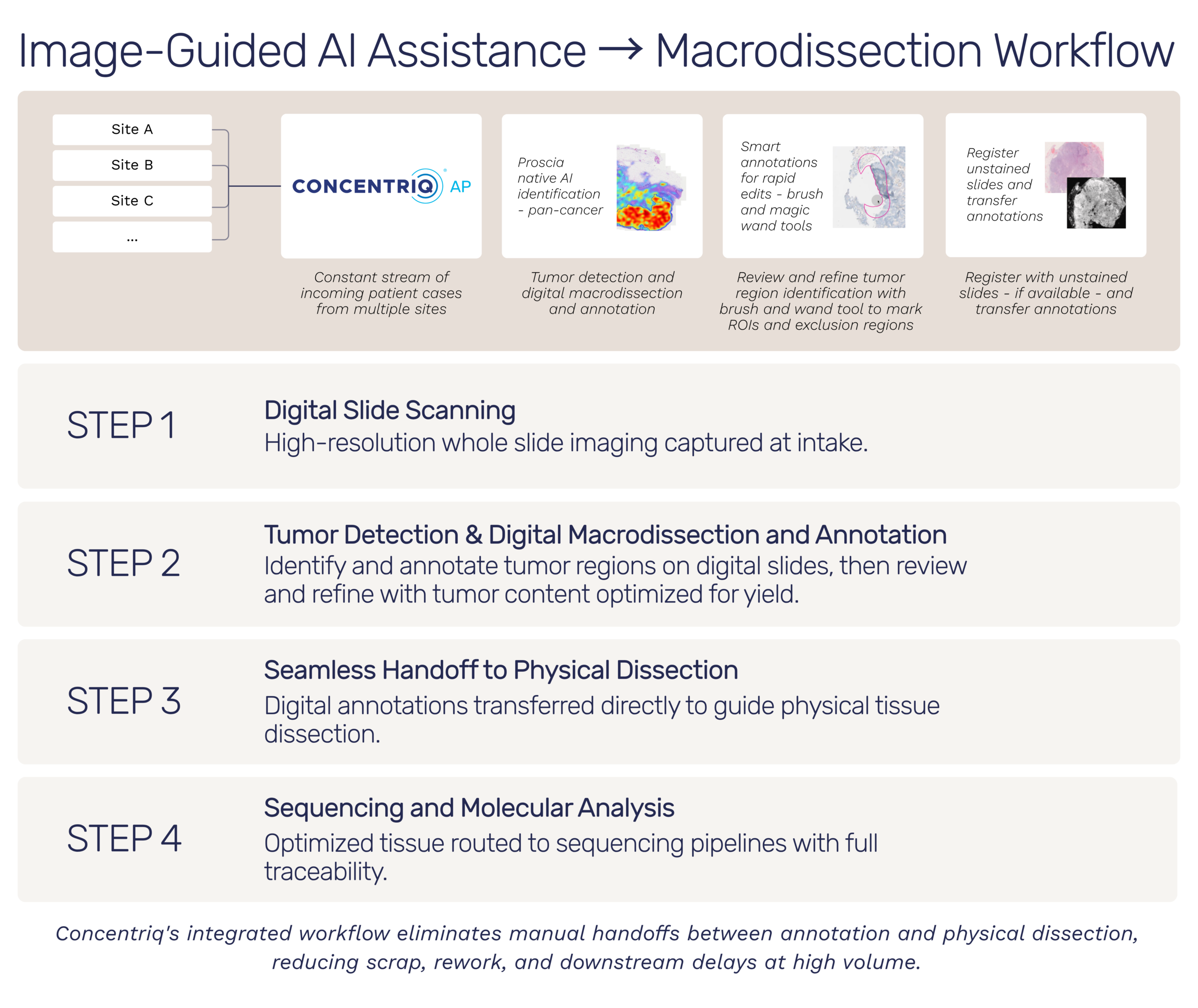
These workflows are most effective when configured collaboratively – combining platform capabilities with direct feedback from precision medicine teams actively running high-volume molecular programs. That collaborative configuration model is core to how Proscia works with its customers.
- Digital macro-dissection and tumor annotation enable precise tissue selection without repeated slide re-review
- AI-driven tumor detection improves tissue yield and reduces the subjectivity of manual selection
- Seamless annotation transfer from digital review to physical dissection workflow eliminates transcription errors and manual re-interpretation
- Reduced scrap and rework at the tissue preparation stage protects downstream sequencing investment and turnaround time
Building a Data Advantage That Compounds
Pathology images are uniquely information-dense. Two patients with identical mutation profiles may have fundamentally different outcomes based on tissue architecture, tumor heterogeneity, and cellular interactions that only pathology can reveal. As digital pathology becomes embedded in routine workflows, the data generated – linked to genomic and clinical records in privacy-preserving ways – becomes a strategic asset.
Concentriq enables structured data capture from day one, open access for research and analytics pipelines, and governance frameworks that enable data reuse at scale.
In precision medicine, the organizations winning long-term aren’t just processing more cases. They’re building intelligence that no one else has.
Deploying and Co-Creating AI at the Speed of Science
Proscia’s AI commitment goes beyond platform capability and extends into how we partner with precision medicine organizations to build, deploy, and commercialize AI together.
The most valuable AI in precision medicine won’t be built by vendors alone or by labs alone. It will be built together—and Proscia is designed to make that possible.
The AI opportunity in precision medicine is too large and too varied to be served by a single approach. Whether you need to deploy existing algorithms faster, access validated third-party models, or build proprietary diagnostics that become a market-differentiating product, Proscia meets you where you are, and grows with you from there.
- Co-development program for building proprietary AI models with Proscia’s scientific and engineering teams
- Third-party AI ecosystem with pre-integrated, validated algorithms deployable through Concentriq without custom engineering
- Regulatory readiness for AI-based companion diagnostics, with validation workflows and audit requirements built into the platform
- Scalable AI model deployment across customer sites with consistent versioning, validation, and monitoring
- Revenue-share commercialization enabling precision medicine organizations to go to market with AI products and share in the economic upside
- Network-scale deployment across a large installed base, enabling precision medicine organizations to move AI and companion diagnostics from development to deployment
Why Partnership Matters as Much as Platform
Precision medicine organizations need a partner who understands that their challenges are operational, scientific, and strategic all at once—and who is invested in solving them over the long term.
This distinction shapes everything about how Proscia works with customers. Concentriq’s purpose-built molecular pathology workflows were developed in close collaboration with precision medicine teams running high-volume programs in real production conditions.
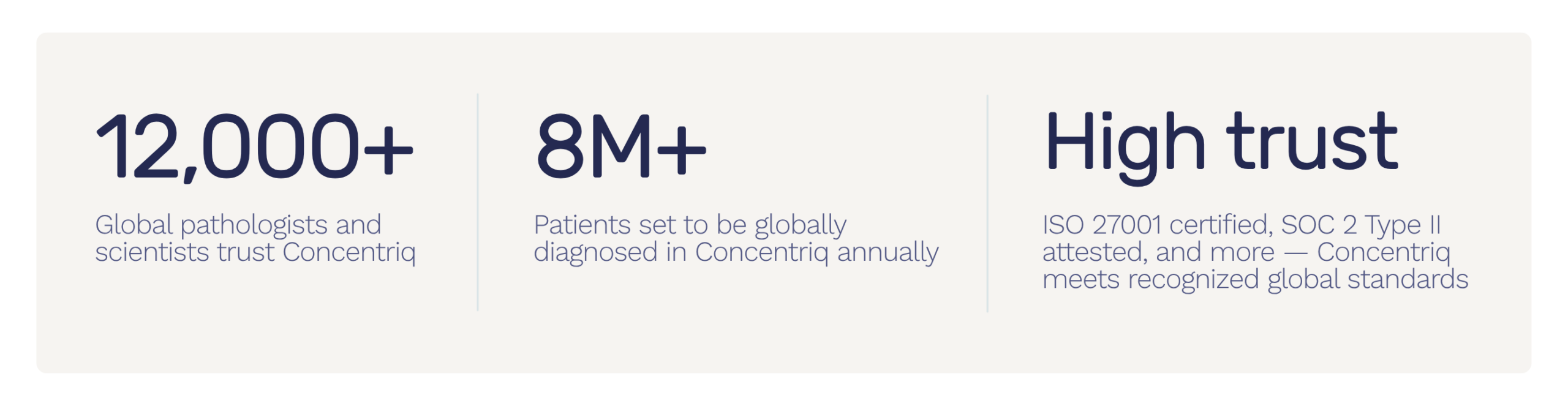
That collaborative model extends beyond implementation. As precision medicine evolves and faces new diagnostic modalities, emerging AI applications, changing regulatory pathways, and more, we evolve with our customers. In recognition of our platform capabilities and the depth of our customer success and relationships, Proscia was named Global 2026 Best in KLAS for Digital Pathology in Europe and received the top score in their US digital pathology evaluation—and 100% of KLAS-surveyed customers would buy again.
The right digital pathology partner doesn’t just implement technology. They help you figure out where technology creates the most leverage for your business.
For digital-native precision medicine companies, that often means accelerating AI commercialization. For reference labs expanding into molecular, it means a structured path to new revenue without unnecessary capital risk. For both, it means infrastructure that grows with them—not one that has to be replaced when volumes double.
Evaluating Digital Pathology for Precision Medicine: The Right Questions
Selecting a digital pathology platform is less about feature comparison and more about long-term strategic fit. The right questions reveal whether a platform will scale with your organization, support evolving workflows, and unlock the full value of your data.
- Can this platform scale with our case volumes and growth trajectory? How does performance hold as slide volumes increase year over year? What does uptime and system support look like in a high-throughput production environment?
- Is AI treated as infrastructure—not an integration project? Can models be developed, deployed, and iterated without re-architecting the system? What does consistent deployment across distributed partner environments look like in practice?
- Does it support molecular and translational workflows—not just image viewing? Can digital annotations flow seamlessly into tissue preparation and sequencing workflows? How does the platform reduce scrap, rework, and downstream delays at high volume?
- How flexible is integration across our partner ecosystem? Can it support multiple scanner vendors, LIMS and LIS systems, and evolving analytics or sequencing platforms as partnerships grow?
- Will it enable a data asset—not just data storage? How easily can pathology data be combined with genomic and clinical data for research, trial recruitment, and biomarker discovery—while maintaining privacy and governance?
- Does it support AI commercialization and regulatory pathways? What capabilities exist for validation, versioning, and deployment of AI models intended for regulated diagnostic or CDx use?
- What does the AI partnership model look like? Can the vendor help integrate third-party AI, co-develop proprietary models, and structure revenue-share arrangements that align incentives on both sides?
- What does the relationship look like beyond implementation? How does the vendor engage with your workflows, your science, and your growth strategy over time—not just during onboarding?
- Can development and deployment happen on the same platform? Can you build and validate AI models or companion diagnostics in one environment and seamlessly deploy them into clinical workflows without re-platforming or duplicating infrastructure?
Built for What Precision Medicine Is Becoming
The organizations defining the future of precision medicine are not waiting for their infrastructure to catch up to their ambition. They are making infrastructure decisions now that will determine how fast they can scale, how broadly they can deploy AI, and how deeply they can build a data advantage that no competitor can easily replicate.
That infrastructure is an enterprise digital pathology platform. One that orchestrates molecular workflows, enables AI at scale, integrates across health system networks, and compounds in strategic value as volumes grow.
Proscia built Concentriq to be that platform—in close collaboration with the precision medicine organizations that understand what it actually takes to operate at this scale.
Ready to see what this looks like for your organization?
Discover how Concentriq AP* can help your laboratory tackle the biggest challenges in anatomic pathology—through these enhancements and beyond.
Connect with a Proscia digital pathology expert.
References
1. DaCosta Byfield S, Bapat B, Becker L, et al. Biomarker Testing Approaches, Treatment Selection, and Cost of Care Among Adults With Advanced Cancer. JAMA Netw Open. 2025;8(7):e2519963. doi:10.1001/jamanetworkopen.2025.19963
2. Kehl KL. Biomarker Testing in Advanced Cancer [Invited Commentary]. JAMA Netw Open. 2025;8(7):e2519972. doi:10.1001/jamanetworkopen.2025.19972
*Concentriq AP is for Research Use Only. Not for use in diagnostic procedures. Proscia’s AI applications are available for research use only.
