Written by Alan Stoddart, Managing Editor and Imogen Fitt, Principal Analyst
The advent of digital pathology has transformed what was a laboratory-bound practice tied to the glass slide into one that can be undertaken remotely and which can tap into the rich data contained in each whole slide image. In doing so, many of the pressures faced by the discipline, such as a lack of pathologists, difficult collaboration between cross-specialist teams, and the need to keep pace with increasingly complex cases have been at least partially alleviated.
Digital pathology’s benefits to diagnostic laboratories aren’t limited to the routine clinical practice, however. The data-driven approach also unlocks closer ties between clinical care and the breakthroughs in drug discovery and development that are advancing how we diagnose and treat disease. This synergy between diagnostic labs and life sciences organisations will help bring the broader vision of precision medicine within reach, where therapies are tailored to individuals and novel breakthroughs can be brought to patients more quickly based on the rich insights digital pathology provides. Ultimately, data-driven pathology and the flywheel it enables lead to better patient outcomes than those achievable under today’s one-size-fits-all model.
Beyond the clinical and innovation value, the digitisation-enabled connection between biopharma and diagnostic labs also addresses what’s historically been one of the most significant challenges that has hampered digital pathology adoption – the economics. While the digital transition is already well underway, the pace of progress varies widely, with some laboratories advancing rapidly while others struggle to establish momentum. Among the most significant barriers preventing laboratories from advancing their digital pathology programmes today is justifying the cost of adoption. Transitioning to a digital workflow requires considerable investment in hardware, software, and supporting infrastructure, including secure data storage for high-resolution image files.
For the laboratories looking at digitisation in the near future, a clear, near-term avenue to measurable return on investment can address these financial considerations and accelerate the pace of adoption.
Interconnected Value
When considering return on investment, healthcare stakeholders benefit from taking a broader view of digital pathology’s role within the wider healthcare and research ecosystem. Traditionally, clinical and research laboratories have operated as separate domains. Increasingly, however, new sources of value are emerging through closer interaction between the two, as data exchange and collaboration create opportunities that extend beyond each sector’s established boundaries. Pathology’s digitisation creates that data medium upon which that engagement can occur more regularly and with greater value delivered.
As shown in the figure below, continuous data and insight exchange between research and clinical practice is key to unlocking precision medicine. This feedback loop accelerates discovery, validates outcomes in real-world settings, and shapes the next wave of innovation.

New diagnostic techniques, along with new therapies, are first born out of research laboratories in academia and in industry. These innovations undergo robust development and testing, and are then applied in diagnostic and clinical practice. In turn, as the clinical market digitises, the real-world data produced can be utilised to support further innovation at a quicker pace and with deeper insight. Such a shift has already been seen in genomics, where research has led to clinical innovation, which itself produced swathes of data invaluable to vendors focused on delivering the next clinical development.
Pathology labs are now catching up, and in recent years, the rate of innovation is so significant that this bridge between areas has become one of the closest within the broader healthcare ecosystem. This synergy empowers pharmaceutical and biotechnology vendors to move quickly and deploy their new solutions within clinical settings using LDTs and other such frameworks, leveraging existing technology stacks already deployed in clinical practice as a platform for the delivery of novel tests and assays. Crucially, vendors developing innovative solutions also benefit from quick, precise feedback that these digital frameworks enable, helping them understand how effective their solutions are in the wider world.
This has far-reaching implications. For example, by necessity clinical trials can only test on small populations. Pharma and life sciences must then undertake surveillance studies to ensure everything is as effective post-market as it is pre-market. Digital pathology offers a means of facilitating and accelerating those post-market observational studies without disruption to the routine diagnostic practice and at a much lower overall cost.
There are, therefore, notable advantages of close integration for both clinical and research users, with pathologists getting innovations more quickly, and research being undertaken more efficiently and effectively.
The Technology at the Centre
Digital pathology software acts as a crucial enabler of this synergy, bridging clinical and research environments by accelerating data exchange and supporting more connected analysis and insight delivery. To fully realise this potential, however, a software solution specifically designed to operate at this interface is required.
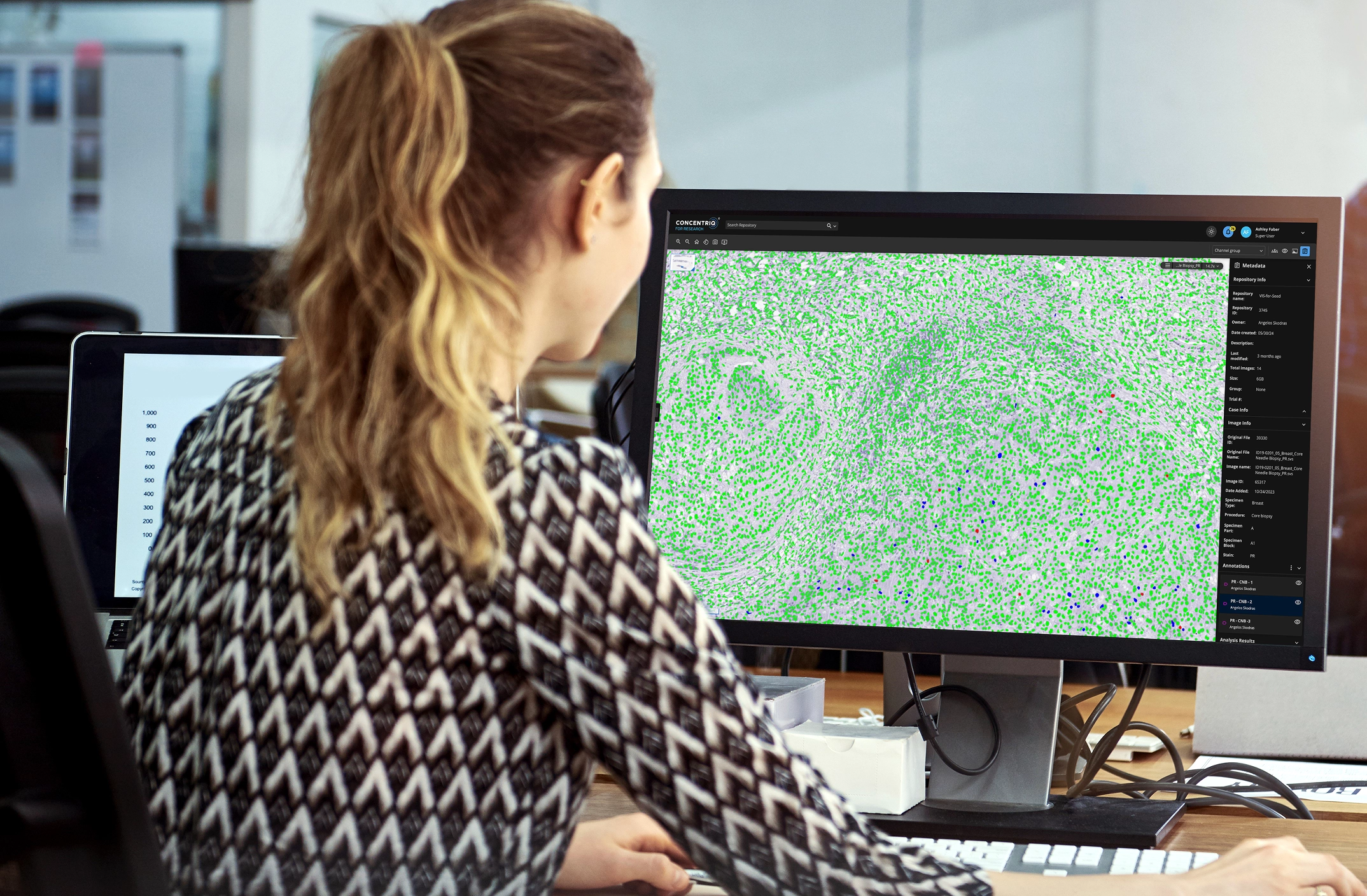
This is where Proscia’s new Aperture software comes in as a potential solution. Resting atop Proscia’s Concentriq platform, which is on track to support the diagnosis of eight million patients this year, Aperture is a solution that automatically identifies candidates at the moment of diagnosis. The solution leverages AI to transform routine pathology data into meaningful insights, equipping biopharmaceutical companies with additional intelligence as they identify patients suitable for clinical trials, enrich their understanding of suitable targets and biomarkers, and develop novel approaches to ensuring that every eligible patient receives the latest, most targeted therapies.
This is a significant advance, enabling suitable candidates to be identified before they are prescribed another treatment pathway, and without the need for another step in a separate software solution. This immediately gives pharmaceutical firms faster visibility of the candidates and the pathology data they require to accelerate the development of new treatments compared to existing solutions that rely on EHR interfaces. Candidate recruitment is, after all, a major headache for pharmaceutical companies, with recruitment of participants taking up to 30% of drug development timelines and costing around $1.2bn. This challenge causes delays for many clinical trials of between one and six months, costing the pharmaceutical industry between $600,000 and $8 million for each day of delay.1
Providers also stand to benefit directly by enabling more patients to access clinical trials and reducing the number of eligible participants missed under current procedures. This not only improves patient outcomes but also creates new revenue opportunities for providers through the identification and referral of suitable trial candidates.
Beyond clinical trial matching, Aperture’s capabilities extend into several other areas that can generate value for its users. It can assist in the generation of evidence for regulatory submissions, companion diagnostic development, label expansion, and payer negotiations — strengthening the connection between clinical practice, research, and commercial outcomes.
In doing so, Aperture is positioned to help create immediate and long-term economic value for digital pathology adoption. Its touted ability to generate revenue through clinical trial recruitment and pre- as well as post-market evidence generation should deliver a clear financial incentive, easing the costs of digital transition and reinforcing adoption among enterprise decision makers. Over time, it also creates an opportunity to bring novel, revenue-generating assays and tests back into routine pathology workflow.
Digital Pathology and Companion Diagnostics
There is also additional value yet to be realised. Pharmaceutical and life sciences vendors are, for example, investing heavily in companion diagnostics, whereby tests are developed for specific biomarkers which indicate a particular condition, which the pharma vendor is able to treat. Among the challenges faced by these CDx vendors is the lack of clarity around the prevalence of a particular biomarker in a given population. This leaves the pharma company exposed to the risk of developing a solution which flags fewer patients than are needed to offset the cost of its development.
Solutions such as Aperture could help alleviate this risk by offering biomarker prevalence functionality. In doing so, pharmaceutical vendors will not only be able to identify more candidates based on biomarkers that are available in laboratory-detected data, but, also analyse whole slide images to quantify biomarker expression on individual patients and see the prevalence of these biomarkers in patient populations. Aperture can then support recruitment of targeted patients for clinical trials that depend on information stemming from pathology images. Finally, Aperture can also play a role in identifying which lab that developed and validated image-based companion diagnostic assay would best be deployed to help the most number of patients.
Such applications are among the factors reshaping the role of pathology. While it is currently viewed largely as a cost centre, the adoption of tools like Aperture signals a gradual shift in that perception. As the benefits of digital pathology are realised, its value extends beyond efficiency and workflow improvements to strengthening pathology’s strategic position within hospitals. In increasingly multidisciplinary care environments, pathology is set to become a central pillar in advancing precision medicine and supporting more integrated, data-driven approaches to patient care.
A Collaborative Approach
Achieving this value creation at scale will take both time and collaboration between digital pathology technology companies and diagnostic labs. Laboratories need to ask their technology partners how they will support the case for digitisation, and what return on investment is possible today and in the foreseeable future.
Labs also need to know what is on their vendors’ roadmaps, and how they will invest in digital pathology going forward, after all, fears of orphaned solutions are a dealbreaker for many.
Ultimately, providers are keen to reap the benefits of digital pathology, but, understandably, are wary of an expensive transition if there is no clear return on investment. Vendors can, and should, ameliorate these concerns, sharing their vision of the future with the laboratories they partner with and showcasing a clear path to return on investment, whether through efficiency and quality improvements in the routine workflow or through new opportunities stemming from the insights derived from their data.
Proscia’s new Aperture solution could be the right approach for vendors to take. By creating both a compelling vision of value creation as well as a clear roadmap to its realisation, Aperture can help advance pathology’s role in healthcare’s tailored future while enabling labs to confidently expand their adoption of digital pathology
About Imogen Fitt
Imogen joined Signify Research in 2018 as part of the Healthcare IT team. She holds a 1st class Biomedical Sciences degree from the University of Warwick. Since joining the team, Imogen has studied various healthcare markets and is now expanding Signify Research’s coverage in Digital Laboratory & Lifesciences markets. She has published reports on Breast Imaging, General Radiography, AI in Drug Development and Clinical Trials, LIS/LIMS, digital pathology, oncology IT, and Real-World Data.
About Alan Stoddart
Alan joined Signify Research in 2020 to lead the company’s Editorial and Insight services. During his tenure at Signify Research, he has developed engaging trend analysis services spanning multiple areas within healthcare technology, including medical imaging, healthcare IT, generative AI, and, more recently, digital pathology and life sciences.
About the Digital Laboratory & Lifesciences Team
The Digital Laboratory and Lifesciences team provides market intelligence and detailed insights on the multiple healthcare technology markets where the clinical world intersects with the preclinical. Our areas of coverage include digital pathology, laboratory information systems, clinical Real-World Data (cRWD) platforms, oncology information systems, tumour board software, oncology decision support software and radiotherapy IT. Each report provides a data-centric and global outlook of its markets with granular country-level insights. Our research process blends primary data collected from in-depth interviews with healthcare professionals and technology vendors to provide a balanced and objective view of the market.
About Signify Research
Signify Research provides Healthtech market intelligence powered by data that you can trust. We blend insights collected from in-depth interviews with technology vendors and healthcare professionals with sales data reported to us by leading vendors to provide a complete and balanced view of the market trends. Our coverage areas are Medical Imaging, Clinical Care, Digital Health, Diagnostic and Lifesciences and Healthcare IT.
Clients worldwide rely on direct access to our expert Analysts for their opinions on the latest market trends and developments. Our market analysis reports and subscriptions provide data-driven insights that business leaders use to guide strategic decisions. We also offer custom research services for clients who need information that can’t be obtained from our off-the-shelf research products or who require market intelligence tailored to their specific needs.
More Information
To find out more: E: enquiries@signifyresearch.net T: +44 (0) 1234 986111 www.signifyresearch.net
References
1. Chaudhari N, Ravi R, Gogtay NJ, Thatte UM. Recruitment and retention of the participants in clinical trials: Challenges and solutions. Perspect Clin Res. 2020 Apr-Jun;11(2):64-69. doi: 10.4103/picr.PICR_206_19. Epub 2020 May 6. PMID: 32670830; PMCID: PMC7342338.