

Blog Post
Put your proprietary AI to work across R&D
Kyriakos Toulgaridis, Staff Reliability Engineer
01 Sep 2026

How Concentriq helps life sciences organizations deploy and scale internally developed pathology AI models, without building and maintaining the infrastructure around them
Data science and AI teams at life sciences organizations do not lack promising ideas, or the expertise to translate them into strong AI capabilities. They are building pathology AI models to identify novel biomarkers, quantify tissue phenotypes, support cohort selection, and more. Foundation models, open-source tools, and AI-assisted development are making the model-building toolkit more powerful and accessible.
So why do so few of these models become part of production R&D workflows? Because a scientifically useful model is only one part of what it takes to create value. Across life sciences, organizations are struggling with translating their AI investments into measurable impact. In Deloitte’s 2026 survey of biopharma C-suite executives, only 22% said their organizations had successfully scaled AI, and just 9% reported significant returns.
One important part of closing that gap is the infrastructure needed to put models to work reliably at scale. Running pathology AI across R&D requires production-grade infrastructure — scheduling, scaling, failure recovery, observability. Establishing that environment for pathology data can require months of cloud provisioning, compliance validation, and security documentation, all before a single image gets processed.
Research teams can't do this on their own, and enterprise IT teams are balancing security, compliance, and platform requests from across the organization. The result is a deployment path that rarely moves at the pace of research. Every new model means starting the process over again, and the overhead keeps compounding.
Even for teams that push through these infrastructure barriers, running data outside its governed environment makes security and compliance a lot harder to maintain. Meanwhile, the model loses value while sitting in limbo — study readouts arrive late, and trial windows narrow. Every quarter a model sits idle is a quarter of unrealized return on the R&D investment that built it.
For data science and AI leaders, this is the last-mile problem. Organizations need to deploy models against governed data, monitor it in use, preserve its provenance, and return its results to the scientists and pathologists making decisions. Proscia is committed to helping customers overcome this complexity and put their science and intellectual property to work by providing a low-lift, secure, and scalable path for deploying the models they develop and turning them into meaningful R&D impact.
Close the infrastructure gap between model and impact
Concentriq Compute is a fully managed compute service built into Concentriq, Proscia's pathology AI platform. It gives data science and AI teams a clear handoff between model development and managed deployment. Your containerized workloads can be deployed, managed, and scaled on secure Proscia-managed infrastructure, with no environment to provision and no clusters to maintain. So you can go from a model that's ready to a model that's running in days, not months.
Your team provides the containerized workload, specifies its CPU or GPU requirements, and chooses whether to trigger runs through the Concentriq interface or by API. Proscia manages scheduling, execution, scaling, recovery, and lifecycle management. Results return directly to Concentriq, connected to the source image and ready for review or downstream analysis.
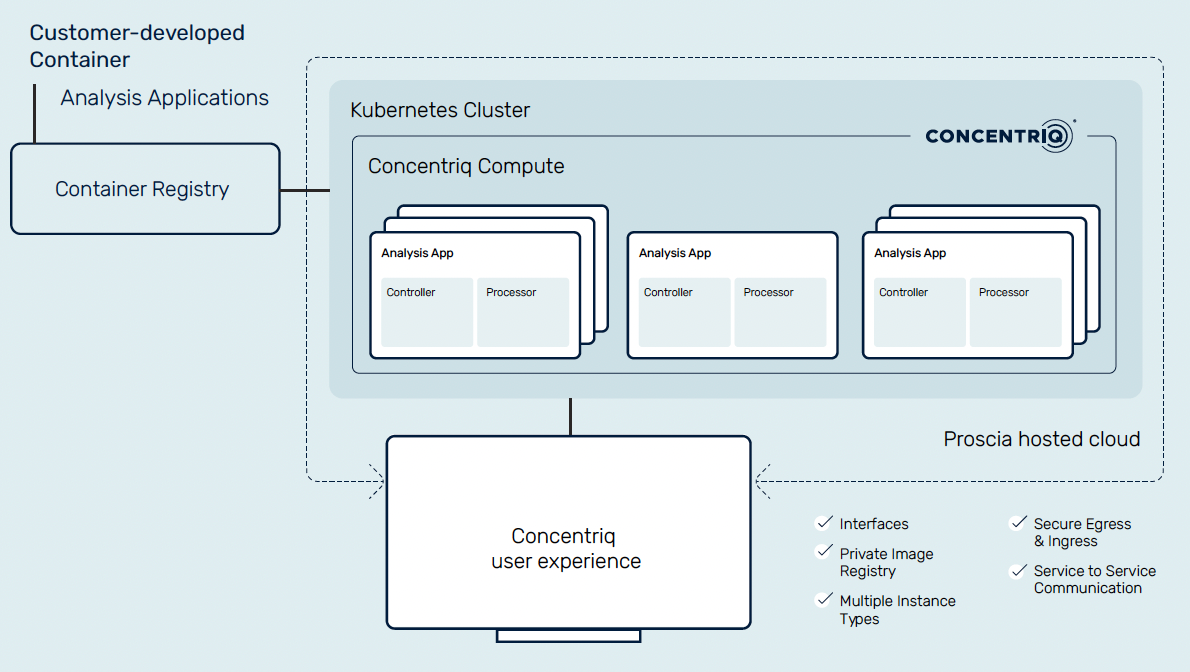
Because the compute layer is connected to your organization's pathology system of record and system of work, you can operationalize models without creating a parallel data environment or asking pathologists and scientists to adopt separate tools and workflows.
A deployment model designed for enterprise AI
Here's where Concentriq users are seeing the greatest value:
Move from ready to running in days. A scientifically ready model shouldn't have to wait months for infrastructure to catch up. With Concentriq Compute, you move from first model run to enterprise-scale deployment in days, eliminating the repeated server provisioning, approvals, and procurement cycles that were never designed for the pace of research.
Scale your models, not your overhead. Each new model follows the same deployment pattern instead of requiring a new infrastructure project. This means you can scale across therapeutic areas and study cohorts without waiting on IT capacity or budget. If a model fails mid-run, recovery happens automatically. If demand spikes, resources scale to meet it. If there's nothing to do, they scale down to zero, and you pay for what you use.
No data exports, duplication, or transfers. We don't move the data to the tools. Models run directly where the data lives, so sensitive pathology data never has to leave its governed, GxP-ready environment. That alone removes the security review cycles, validation burden, and compliance exposure that comes with moving data around.
Every run grows your data foundation. Every AI output returns to Concentriq connected to the source image, metadata, and analysis run that produced it — not sitting on a researcher's laptop somewhere in your organization. Over time, those results compound into a searchable, traceable data foundation you can query across studies to fuel new model development and inform portfolio strategy.
How it works in practice
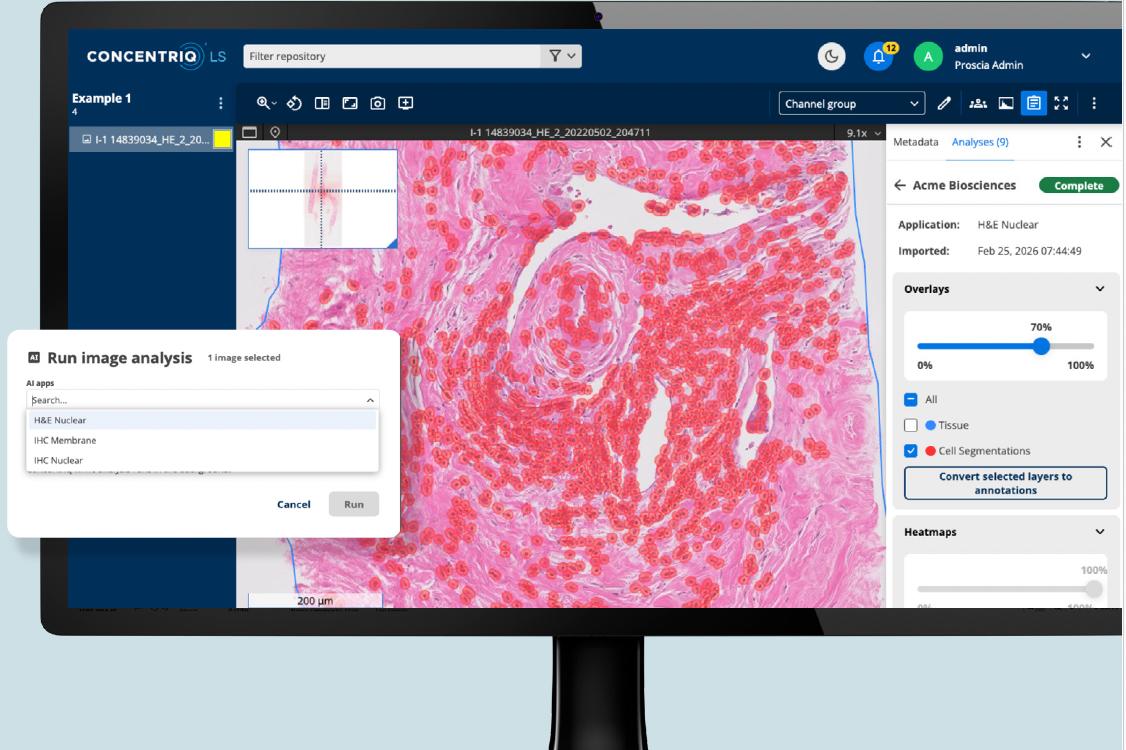
Consider a team that has fine-tuned a cell detection model in QuPath, one of digital pathology's most widely used open-source analysis platforms, and now needs to run it at enterprise scale. With Concentriq Compute, deploying that model is a processor container and a configuration file. The result is a full production deployment delivered in days, with scientists viewing cell detection results rendered directly as overlays alongside the original whole slide image in Concentriq. The next model deploys exactly the same way.
Models integrated through the API show up right in the workflows pathologists and scientists already use, whether that's triggered through the Concentriq viewer during routine image review or programmatically via API for batch processing. AI outputs come back as overlays, heatmaps, and structured results within the viewer, alongside every other image analysis tool already running on the platform. The value is not simply that the container ran. An internally developed method can now be applied consistently across a study cohort, with results returned in context for scientists to review, compare, and use in downstream decisions.
This isn't infrastructure we ask customers to adopt without relying on it ourselves. Proscia's own production workloads run on the same platform, held to the same quality bar.
It's time to measure AI success by outcomes, not model count
In our conversations with data science and AI leaders across biopharma, we hear the same thing: AI programs have to prove the value they deliver to R&D, not simply the novelty of the science or the number of models built. A 2026 Journal of Pathology Informatics review makes the same point: AI-enabled pathology now supports stratification, companion diagnostics, trial enrichment, and real-world evidence across the drug development lifecycle. But the real test is whether those models generate evidence sooner, sharpen go/no-go decisions, and compound value across studies and programs.
A model sitting on a local computer may represent excellent science, but until it becomes part of a reliable and repeatable workflow, its potential remains unrealized.
That’s why Proscia is committed to giving these teams what they need most right now: a dependable route from research investment to operational results. With Concentriq Compute, organizations can move their AI models beyond development and put them to work across studies, cohorts, and programs, without requiring scientists to become infrastructure operators or creating another disconnected environment for pathology data.
To learn more about how Concentriq can accelerate your AI programs, download our data sheet or talk to our team.
Concentriq AP and Concentriq LS are for Research Use Only. Not for use in diagnostic procedures. Proscia’s AI applications are available for research use only