

Blog Post
Choosing the Right Digital Pathology Platform: 7 Criteria for a Better Experience with Your AI Applications
Jeni Gruensfelder
29 Oct 2026

Labs now expect their digital pathology platform to offer a broad range of AI applications from multiple vendors. But access alone isn’t enough. The platform also shapes how pathologists and lab teams experience these applications and the value they derive from them in daily practice.
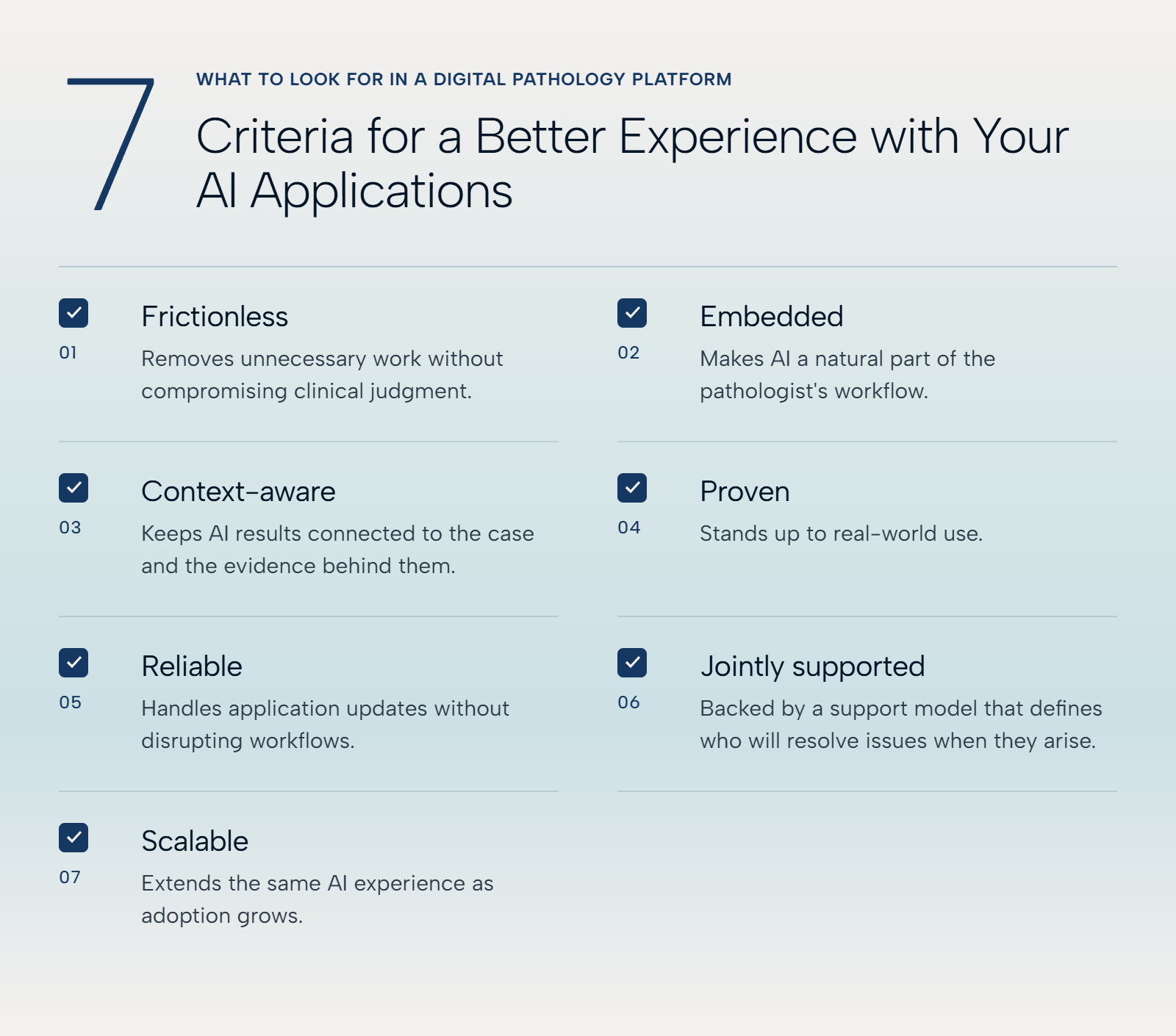
Choosing a digital pathology platform for your lab involves many considerations. This framework focuses on one important aspect: how well a platform supports AI applications. It outlines seven criteria for pathologists, lab directors, and IT stakeholders to consider, along with practical questions to ask vendors during an evaluation.
1. Frictionless
Removes unnecessary work without compromising clinical judgment.
The platform should eliminate unnecessary manual steps so that pathologists can focus on high-judgment work. For example, pathologists shouldn’t have to log in twice, re-enter case information across systems, or manually configure a routine analysis when the information required to do so is already available.
The same applies to the wider lab team. Histotechs and other staff should know when a case is ready for analysis and whether the right algorithm is assigned to the slide. The platform should make case status clear without introducing duplicate data entry or unnecessary handoffs.
Demos rarely reveal the friction created by manual work. They’re often scripted or rely on behind-the-scenes workarounds. The burden becomes clear too late, only when the integration is used in day-to-day practice across real cases.
Questions to ask
- How do I know when a case is ready for AI analysis to begin, and what steps are required to get it started?
- How does the platform ensure the algorithm runs on the right slide?
- Can routine analyses be configured to run automatically, or must someone initiate each one manually?
- How will a histotech know when a case is ready with applicable AI results for a pathologist to read?
2. Embedded
Makes AI a natural part of the pathologist’s workflow.
Whether an AI application is sourced directly from a vendor or through a marketplace, making it available on a digital pathology platform doesn’t mean it’s seamlessly incorporated into the pathologist’s workflow. Pathologists may still need to leave the platform to complete key steps.
A platform that fully embeds an application into the workflow allows pathologists to initiate an analysis, provide the necessary inputs, review the results, and act on them without navigating elsewhere.
Consider the experience a viewer delivers when it's limited on the number of objects it can render. AI applications that identify large numbers of cells can exceed these limits on a needle core, and even more so on a resection. When the platform displays only some of the results, pathologists may have to open a separate window to see the complete analysis, disrupting their workflow.
Questions to ask
- Can pathologists initiate analyses and review results without leaving the primary platform?
- Can pathologists provide the inputs an analysis requires, such as defining a region of interest, within the primary platform, or do they need to switch to the AI application?
- Can the platform display the full AI result, including outputs with large numbers of objects?
3. Context-Aware
Keeps AI results connected to the case and the evidence behind them.
A pathologist can’t interpret an AI result in isolation. Even when an AI application is embedded in the platform, pathologists still need the case information required to make sense of the result, along with the supporting evidence to verify it. The platform should make that context available alongside the result and keep it connected to the corresponding case.
Consider a quantitative score that returns to the platform while the markups that support it remain in the AI application. The score is available, but the pathologist can’t easily inspect the underlying evidence to verify the result.
Keeping results associated with the right case is equally important. Pathologists may work on other cases while analyses are running in the background. Results should remain linked to the correct case so pathologists can interpret them without having to remember which result belongs where.
Questions to ask
- Does the platform provide AI applications with the case information they need beyond the image itself, even as requirements vary across applications?
- Can pathologists review AI results alongside supporting evidence, such as markups, heatmaps, and quantitative scores?
- Do AI results remain associated with the correct case as pathologists move between cases?
- Where are AI results stored for long-term access, and are the original results preserved alongside the inputs provided by the user?
4. Proven
Stands up to real-world use.
The strongest evidence of how well a platform supports AI comes from labs using it in production.
Customer references can reveal what a demo may not, including how well AI fits into day-to-day workflows and where manual steps or workarounds remain. This feedback is especially valuable from labs with environments and workflows similar to your own.
At the same time, a platform may not yet support a particular AI application that a lab is looking to leverage. In that case, it’s important to understand what’s required to bring the application onto the platform and what commitments the vendor can make around timing and the intended user experience.
Questions to ask
- Which labs are using this application on the platform in production today, and can we speak with one whose environment and workflows are similar to ours?
- If the application isn’t yet supported in production, what needs to be developed or validated to deliver the intended workflow?
- What timeline and concrete commitments exist for delivering that workflow?
5. Reliable
Handles application updates without disrupting workflows.
AI applications evolve frequently, and new versions and capabilities are released on their own schedules. A reliable platform accommodates those changes without requiring repeated integration work or disrupting the pathologist’s workflow.
Reliability also means that IT shouldn’t have to constantly oversee the platform. The team needs visibility into how AI applications are performing, clear alerts when something goes wrong, and a manageable way to coordinate updates. IT can then address issues before they get in the way of day-to-day work.
AI applications will fail from time to time. What matters is how these failures are surfaced, particularly when cases are already in progress. The platform should make clear which cases are affected and what action is needed. Otherwise, a failure may go unnoticed until a pathologist realizes an expected result is missing.
Questions to ask
- As AI applications evolve, how much work is required to support new versions or capabilities?
- What ongoing monitoring and maintenance will our IT team need to manage?
- What happens to cases that are in process when there’s a failure?
- How will we know when an analysis fails or results are delayed, and which cases are affected?
6. Jointly Supported
Backed by a support model that defines who will resolve issues when they arise.
When a problem affects an integration, it isn’t always obvious which vendor is responsible for resolving it. Each may have its own support team and process, leaving the lab to diagnose the issue and act as a go-between.
A joint support agreement defines each vendor’s responsibilities and establishes how issues spanning products will be investigated and resolved. Labs gain a clear process to follow without having to manage the vendors themselves.
Importantly, while purchasing a platform and AI applications through a single vendor simplifies procurement, it doesn’t guarantee coordinated support. Labs should also confirm that a joint support agreement is in place in these situations.
Questions to ask
- Is there a joint support agreement in place between vendors, and what responsibilities does it assign to each?
- Can you walk us through a real example of an issue that crossed products, including how it was resolved and how the lab was supported?
7. Scalable
Extends the same AI experience as adoption grows.
The experience the platform delivers for a single application should hold up as the lab expands its use of AI. That means the platform needs to accommodate new applications and rising case volumes without creating unnecessary complexity or cost.
Adding applications should become easier over time, rather than each requiring a new integration project. A common integration architecture can help a lab grow its AI capabilities while limiting ongoing development and IT work.
Scaling also means accommodating increasing case volumes. AI analysis uses computing capacity, and as more cases are processed, infrastructure requirements, processing times, and costs can rise. Labs should understand how the platform will handle their expected workloads, including periods of peak demand.
Questions to ask
- What does it take to add another AI application, and how much additional development and ongoing IT support will it require?
- How many applications are using the same integration architecture in production today?
- Can the platform accommodate our expected case volumes without significantly increasing processing times or infrastructure costs?
- What happens to processing times and costs as volumes grow or multiple analyses run simultaneously?
- If we want to adopt an application you don’t currently support, what would it take to add it? Are there technical or commercial restrictions on which applications we can use?
- Can the platform support an application that we’ve built ourselves? What technical, security, and validation requirements would apply?
Putting This Framework to Use
A digital pathology platform may offer a broad selection of AI applications, but that alone doesn’t guarantee a good experience. What matters is how well the platform makes those applications part of pathologists’ day-to-day work.
These seven criteria help lab teams look beyond vendor claims and evaluate the experience a platform delivers in practice. You don’t need to ask every question in your first meeting. Start with those most relevant to your lab, then use the rest to guide your evaluation as you narrow your options.